
Running a Sex Offender Check in Walker County
The Texas Public Sex Offender Registry is the main public source for a Walker County sex offender check. Texas DPS maintains the statewide system, while local law enforcement registers and verifies people under Code of Criminal Procedure Chapter 62. Start with the state portal even when the address is in Huntsville, New Waverly, Riverside, or an unincorporated part of Walker County. The state record brings public registration data into one search rather than forcing a user to guess which local office has jurisdiction.
Prepare more than a name for a Walker County search. An address, city, ZIP code, known alias, or physical detail can help distinguish people with similar names. A public Walker County result is a point-in-time record. Read its registration and verification dates, then contact the listed registration agency if an address or compliance status affects a current safety decision. The registry is not a full criminal-history check, and an empty Walker County result does not clear a person of all past cases.
Walker County does not publish a separate verified local registry portal. The practical fallback is the Walker County Sheriff's Office for county registration questions and Huntsville Police for city routing.
Walker County Registry Map Search
The state registry also supports a location and map approach. It is useful when the concern begins with a Walker County address rather than a known name. Enter the street or city information, review the map controls offered in the live system, and open each result before making an inference. A mapped point may reflect the registered location and its last update. It does not establish that every person at that property is registered, nor does it show every type of safety concern near the address.
The official Texas DPS registry search screen shows the name and location entry points used for a Walker County registry search. Those fields keep a Walker County address query tied to the state's official data.
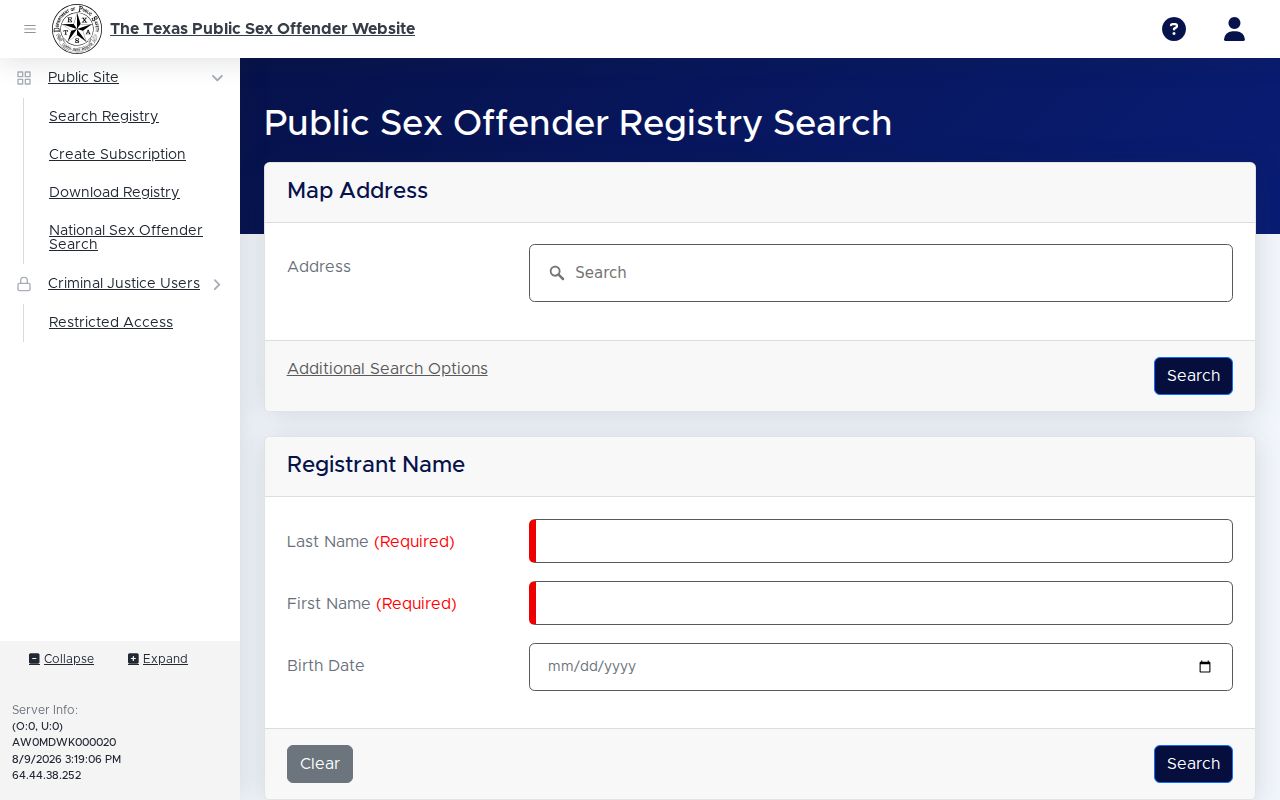
The screen reinforces why the city, county, and address fields should be used with the identity details shown on the full profile.
Searching the Texas Public Sex Offender Registry
Texas DPS provides both name and geographic ways to search Walker County records. A Walker County sex offender check works best when the query begins broad enough to catch spelling or alias differences, then narrows with Walker County place and profile details. Search controls may change, so use the live labels and do not assume that an omitted Walker County result means a record has been removed or sealed.
- Open the official Texas DPS public registry and read the conditions governing public use.
- Enter a last name, or use a Walker County location such as an address, city, ZIP code, or the county filter.
- Review the result list and compare aliases, photograph, physical details, and displayed location before selecting a profile.
- Open the full profile, read the offense and status fields, and note the registration or verification agency and dates.
| Field Label | Type | Required | Notes |
|---|---|---|---|
| Last Name | Text | Depends on search | Used for a name search; test spelling variants where needed. |
| First and Middle Name | Text | No | Narrows a name result when those details are known. |
| Address | Text | Location search | Starts a street or proximity search. |
| City and ZIP Code | Text or choice | No | Use a Walker County city and a five-digit ZIP when known. |
| County | Choice | No | Select Walker to focus the statewide result set. |
| Map Location or Radius | Map control | Map search | Use the radii offered by the live interface. |
Walker County Registry Search Layers
The DPS registry and the National Sex Offender Public Website answer related but different Walker County search needs. DPS is the authoritative Texas source. It supplies the detailed state profile and the registration agency that can verify a Walker County entry. NSOPW searches participating public registries across jurisdictions. It is most useful when a Walker County person or address may connect to another state, or when a move has made a state-by-state search uncertain.
The U.S. Department of Justice national registry interface provides the cross-state layer used after a Texas search.
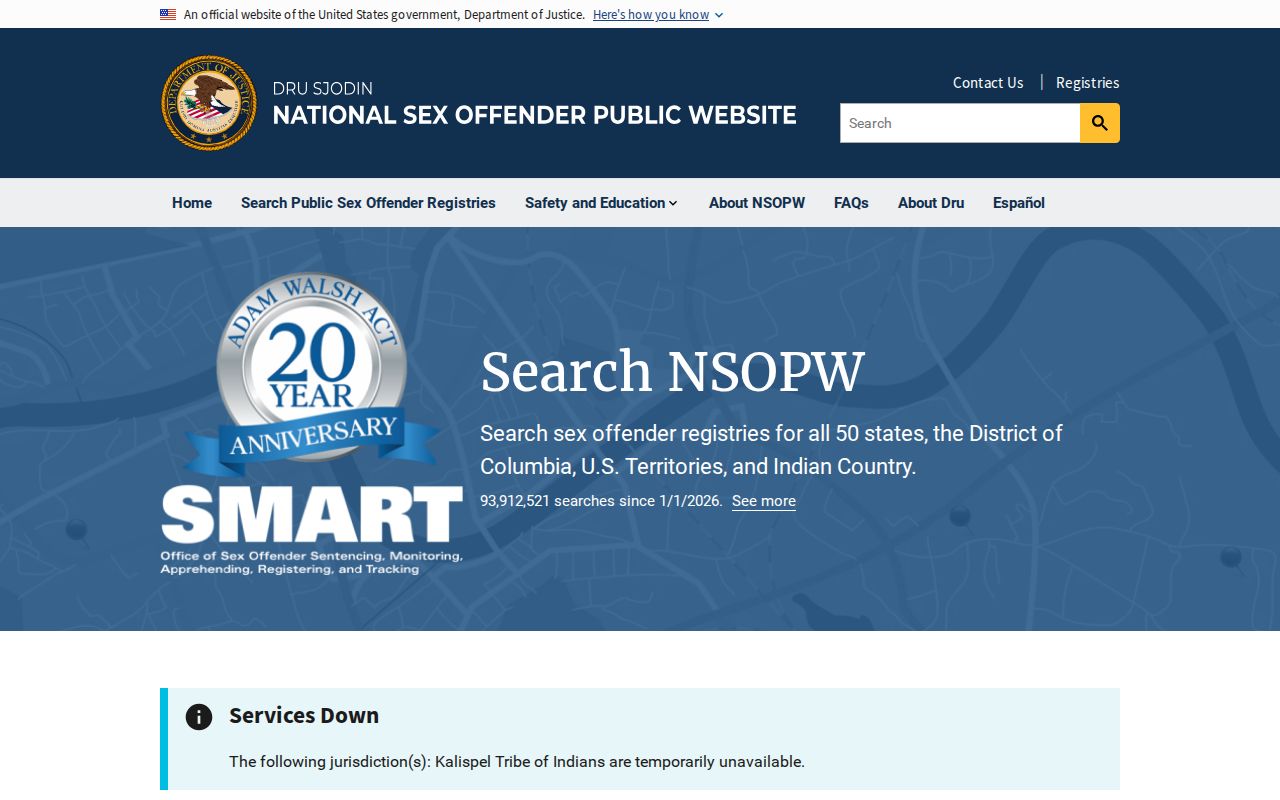
Return to the Texas DPS profile for Texas-specific status, then ask the named registration agency about a material mismatch or stale-looking address.
Note: A national result can widen the search, but the originating state registry remains the source for the detailed public record.
What a Registry Profile Shows
A Walker County registry profile joins identity clues, registration details, and reportable-offense information. Those fields help a reader separate a real match from a similar name. Public display depends on what Chapter 62 permits and what data is populated. Protected victim identity is not part of the profile. Nor should a blank field be filled with a guess. Read the actual values and the dates attached to them.
| Name and Aliases | The current registered name and any public aliases used to compare identity. |
|---|---|
| Photo and Description | A photograph plus public physical details such as sex, race, height, weight, hair, eyes, age, scars, marks, or tattoos. |
| Registered Location | Primary or secondary residence or other location information to the extent Texas law makes it public. |
| Reportable Offense | Public offense description, statute, court or jurisdiction, and conviction or disposition date where shown. |
| Risk and Status | Texas risk level, registration status, and any public compliance, absconded, or civil-commitment indicator. |
| Agency and Dates | The registration or verification agency and relevant update or verification dates. |
| Other Public Data | Vehicles, school, online identifiers, or similar Chapter 62 fields only when public and populated. |
Risk level and registration length are separate questions. The offense, date, and governing statute control the legal duty, not a reader's impression of the profile.
Walker County Registry Risk Labels
Texas profiles may use low, moderate, or high risk descriptors. Those labels come from the Texas risk-assessment framework. They are not the federal SORNA Tier I, II, and III labels, and they do not by themselves reveal when a registration duty ends. Treating a risk word as a fixed duration is a common Walker County registry mistake.
Duration turns on the reportable offense, the governing version of Texas Code of Criminal Procedure Chapter 62, and the applicable release, discharge, or other statutory date. Certain duties are commonly measured to a tenth anniversary. Listed serious or repeat offenses can create a lifetime duty. Juvenile cases have separate rules and possible exemption or deregistration procedures. Verification frequency and community notice also depend on classification and circumstances, so the displayed agency is the sound place to confirm the current local duty.
Registration Requirements and Levels in Texas
Texas separates risk assessment from duration. A Walker County sex offender profile may therefore display a risk label while the offense-based registration period must be read from Chapter 62. The public portal may also show status and verification details, but a user should not calculate an end date from the risk label alone.
| Concept | Duration | Public Meaning |
|---|---|---|
| Low, Moderate, or High Risk | Does not set the end date | Texas assessment descriptors used for notification and management. |
| Ten-Year Duty | Offense-specific statutory period | Commonly runs through the tenth anniversary after the controlling release or discharge date; verify the exact provision. |
| Lifetime Duty | Life unless lawful relief applies | Applies to listed serious or repeat reportable offenses. |
| Juvenile Treatment | Separate statutory rules | Possible exemption or deregistration rules mean an adult duration must not be assumed. |
Community notice can include special measures for specified high-risk circumstances. The DPS profile and the local registration agency supply the current public facts.
Walker County Registry Address Checks
An address can look stale because a move, verification event, or data update has not yet appeared in the public view. First, note the profile's displayed dates and exact registration agency. Next, rerun the location search and check likely aliases. Then contact the agency shown on the profile. For an address outside Huntsville city jurisdiction, the Walker County Sheriff's Office can route registration or compliance questions at 936-435-2400. Within Huntsville, the Police Records Section can route a question at 936-291-5480. Specific counter hours or appointment rules were not confirmed, so call before traveling.
Report suspected noncompliance to the appropriate agency or DPS. Use 911 for an immediate threat. Do not approach a person, enter property, or try to conduct a public compliance check. Local officers and registry staff have the lawful means to verify status.
Note: A displayed address is registry information at its recorded update time, not proof about every person who lives or works there.
Walker County Registry Jurisdiction
The profile's registration agency helps route a Walker County question. Huntsville Police is the city contact for registration issues routed within Huntsville. The Walker County Sheriff's Office handles county registration and compliance questions outside that municipal jurisdiction. The statewide DPS portal remains the public search source for both. A city or county office may verify its own registration work, but it does not replace the DPS search.
Jurisdiction also affects a suspected noncompliance report. Record the public profile link, displayed agency, status, and date that caused concern. Give that information to the appropriate law-enforcement office. For a possible address outside Texas, use NSOPW to identify the other state's public registry, then contact the registration agency named there. Do not try to resolve a jurisdiction question through personal contact with the registrant or household.
Lawful Use and Community Notification
The Texas registry supports personal, family, and community safety planning. It can help a Walker County resident identify public registration information, review the nature of a reportable offense, and find the agency responsible for verification. Chapter 62 may also require added community notice in defined high-risk circumstances. None of those functions turns the registry into permission for private enforcement.
Use the data to make lawful safety choices and to contact officials when a profile raises a current concern. Confirm critical facts with the registration agency. Public information can change, and a similar name or nearby map point can be misunderstood. The broader Walker County criminal-history overview explains why a registry result, a court case, and a DPS criminal-history response are separate records.
Misuse Is a Crime: Do not use Walker County registry information to threaten, harass, intimidate, trespass, vandalize, or confront anyone. Misuse can be a crime under Texas Code of Criminal Procedure Chapter 62 and other Texas law. Report a concern to law enforcement.