
Criminal Cases in Walker County Courts
Walker County criminal court cases are divided by charge level. The 12th and 278th Judicial District Courts hear felony cases, and the Walker County District Clerk maintains their indictments, pleadings, docket entries, judgments, and sentences. The Walker County Court at Law hears Class A and B misdemeanors, with its records supported by the County Clerk. Fine-only state-law offenses and city ordinance cases filed in Huntsville remain with Huntsville Municipal Court. Justice courts also handle fine-only matters within their precinct jurisdiction.
A cause number and court name are the best keys for separating similar names. The same event may create a jail booking, an agency report, and a court case, but the clerk’s file is where a filed charge and judicial result appear. The District Clerk criminal division also processes felony filings, subpoenas, court-ordered capiases, and appellate records. It has required criminal e-filing since January 1, 2019.
Reading Walker County Court Lines
The court line tells a reader which office can produce a complete Walker County criminal case file. A felony caption naming the 12th or 278th District Court belongs with the District Clerk. A Class A or B misdemeanor in the County Court at Law routes to the County Clerk. A Huntsville citation may share the FM 2821 Justice Building with sheriff functions, yet the Municipal Court remains its own custodian. Co-location does not merge the records.
District Clerk
1100 University Ave., Room 209
Huntsville, TX 77340
936-436-4972
Felony files for the 12th and 278th District Courts
County Clerk
1100 University Ave.
Huntsville, TX 77340
936-436-4696
County Court at Law misdemeanor records
Municipal Court
717 FM 2821 W., Suite 200
Huntsville, TX 77320
936-291-5476
Fine-only city and state-law cases
The county main line is 936-436-4900 when a justice-court directory or another court contact is needed. Confirm the division’s counter hours before travel because the clerk pages describe morning hours, afternoon service from 1:00 to 4:30, and a 4:00 Friday close.
How to Search Case Records
Begin with the official Walker County Tyler/Odyssey portal. It combines public court, justice, sheriff, and jail areas, so select the court record area rather than assuming every result is a court case. Exact cause numbers produce the narrowest results. Name searches need a careful check of the court, filing date, party role, and charge before the record is treated as a match.
- Choose the court division that fits the alleged charge: district, County Court at Law, municipal, or justice court.
- Search by exact cause number when known. Otherwise enter the surname and use the first name to narrow the list.
- Apply a filing date, court, or status filter where the portal makes one available.
- Open the summary and compare the court, charge, docket events, status, and disposition.
- Ask the correct clerk for any missing pleading, order, judgment, or certified copy by cause number and document date.
The re:SearchTX statewide court platform supplies another route for participating Texas courts. Document availability and charges vary, so it should supplement the Walker County clerk channel rather than replace it.
| Field Label | Type | Required | Notes |
|---|---|---|---|
| Record Area | Portal tile or tab | Yes | Choose Courts, Justice, Sheriff, or Jail Records as presented. |
| Name | Text | Usually one criterion | Enter the surname carefully and compare identifiers. |
| Case Number | Text | Optional alternative | The exact local cause number gives the narrowest result. |
| Date Filed | Date or range | Optional | Narrows results by filing period. |
| Court | Dropdown | Optional | Select the participating Walker County court. |
| Status | Dropdown | Optional | An absent case should not be assumed sealed. |
Walker County Misdemeanor Archive Gaps
The County Clerk’s archive has a sharp local limit. Walker County reports no misdemeanor files before 1962, and only judgments remain for the years 1962 through 1987 under the retention schedule. A failed portal search for an older misdemeanor is therefore not proof that no case existed. Historical and genealogy research may require the retained judgment, an index, or another record series held by the clerk.
The County Clerk misdemeanor records page lists a $5 search charge per name or per case when several cases are involved, $1 per copy page, $5 for certification, and a $3 credit-card handling fee. Felony copy costs follow the District Clerk’s current fee schedule, which the office updated effective September 1, 2025. County Clerk prices should not be assumed for a district-court file.
The official County Clerk source illustrates the local access rules and price split.
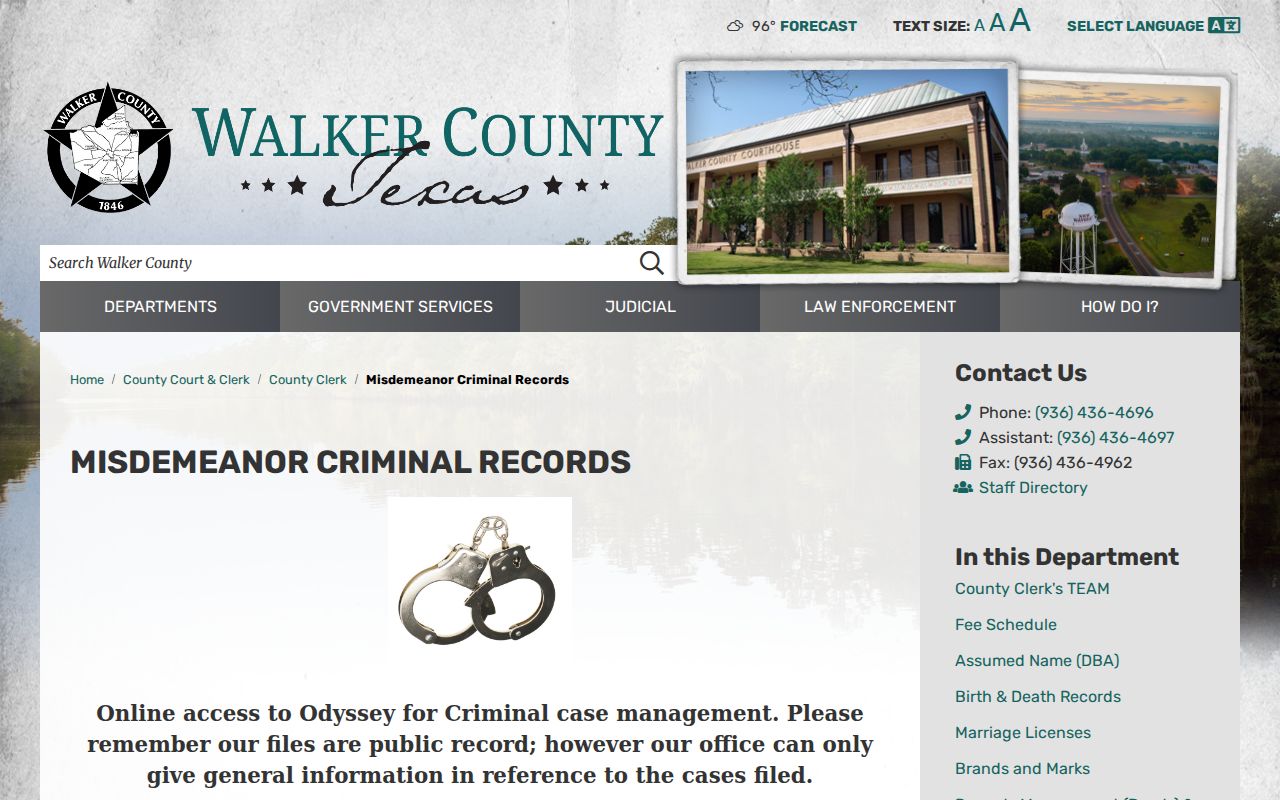
That division-level page is the better source for old misdemeanor coverage than a general portal result.
Note: Ask whether a plain copy or certified copy is needed before paying because certification and page charges serve different record needs.
What the Case File Shows
A Walker County criminal case file organizes the proceeding around its cause number and court. It can contain the charging paper, appearances, motions, settings, orders, plea, judgment, sentence, and financial entries. The online summary may list an event without displaying the underlying document. A pending status means the docket has not yet reached a final disposition, and an arrest charge can differ from the charge that prosecutors later file.
| Case Number & Court | Identifies the local cause and the district, county, municipal, or justice court responsible for it. |
|---|---|
| Charging Document | A complaint, information, or grand-jury indictment states the accusation filed in court. |
| Docket Entries | Chronological clerk entries can show filings, motions, settings, warrants, appearances, and orders. |
| Hearing Dates | Arraignment, pretrial, plea, trial, revocation, and sentencing settings may appear. |
| Disposition & Judgment | The recorded result may be conviction, acquittal, dismissal, deferred adjudication, or another status. |
| Sentence & Conditions | Confinement, fine, costs, restitution, or community supervision appears when ordered and public. |
Public screens omit Social Security numbers and other sensitive identifiers. Victim, minor, juvenile, sealed, expunged, and security-sensitive material can also be redacted or withheld. The actual clerk record controls when a summary label is unclear.
Missing Walker County Court Documents
A document icon or docket entry does not guarantee that the document itself can be opened online. Walker County public summaries may expose the register of actions while requiring a direct clerk request for the pleading or order. Write down the cause number, exact court, event label, and event date before contacting the clerk. Then state whether inspection, an electronic plain copy, a paper copy, or certification is needed.
The District Clerk’s official page links public access and confirms its felony-record duty.
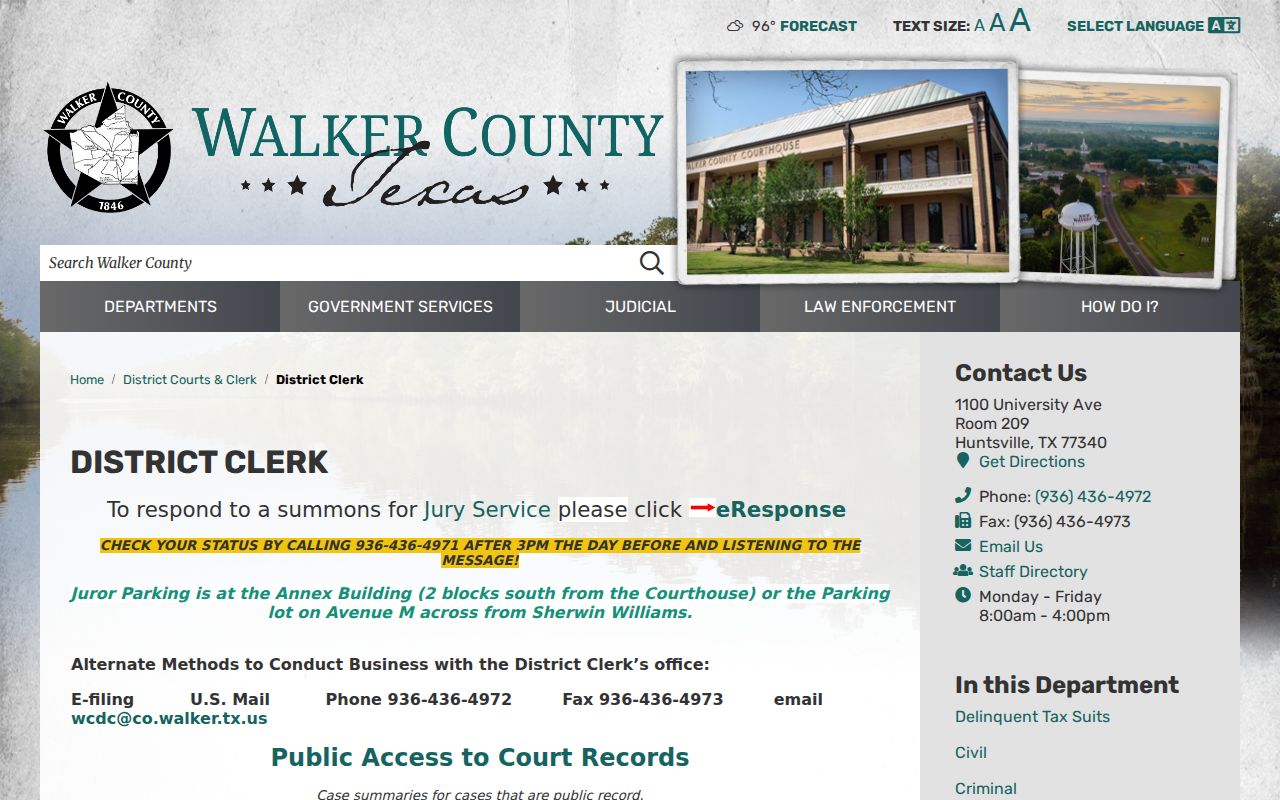
Using the clerk page as the starting point avoids confusing a public summary with the complete felony case file.
For a Municipal Court record, Huntsville requires a written request and states a 7 to 10 business-day processing period. That city timeline does not set a deadline for the District Clerk or County Clerk.
Stages of a Criminal Case
After an agency submits a case, prosecutors decide whether and what to file. A felony may proceed by indictment, while a misdemeanor commonly proceeds by information. Arraignment addresses the accusation and plea. Pretrial entries can include counsel appearances, discovery issues, motions, and settings. The case may then resolve by dismissal, negotiated plea, or trial. A judgment records the legal outcome, and sentencing states the court’s order.
Case flow: Charges Filed › Arraignment › Pretrial › Plea or Trial › Disposition › Sentencing
- Indictment
- A grand jury’s formal felony accusation, also called a true bill.
- Capias
- Court process directing an arrest after a charging or court event.
- Disposition
- The outcome or status resolving a charge.
- Deferred adjudication
- Community supervision without an immediate judgment of guilt; it does not erase the public record by itself.
A motion to revoke or adjudicate can create later docket stages. An appeal from Walker County routes to the 10th Court of Appeals in Waco. Each new event should be read in sequence rather than in isolation.
Walker County Tyler Portal Limits
The live Walker County courts and sheriff portal is the most useful local index, but its record areas answer different questions. A jail result shows custody or booking data. A court result shows a filed case. Neither is the Texas DPS public criminal-history product, and a missing online case may reflect a filter, archive limit, delayed entry, restricted record, or nonparticipating court rather than a clean history.
The official portal source shows the combined landing screen used for Walker County criminal court case research.
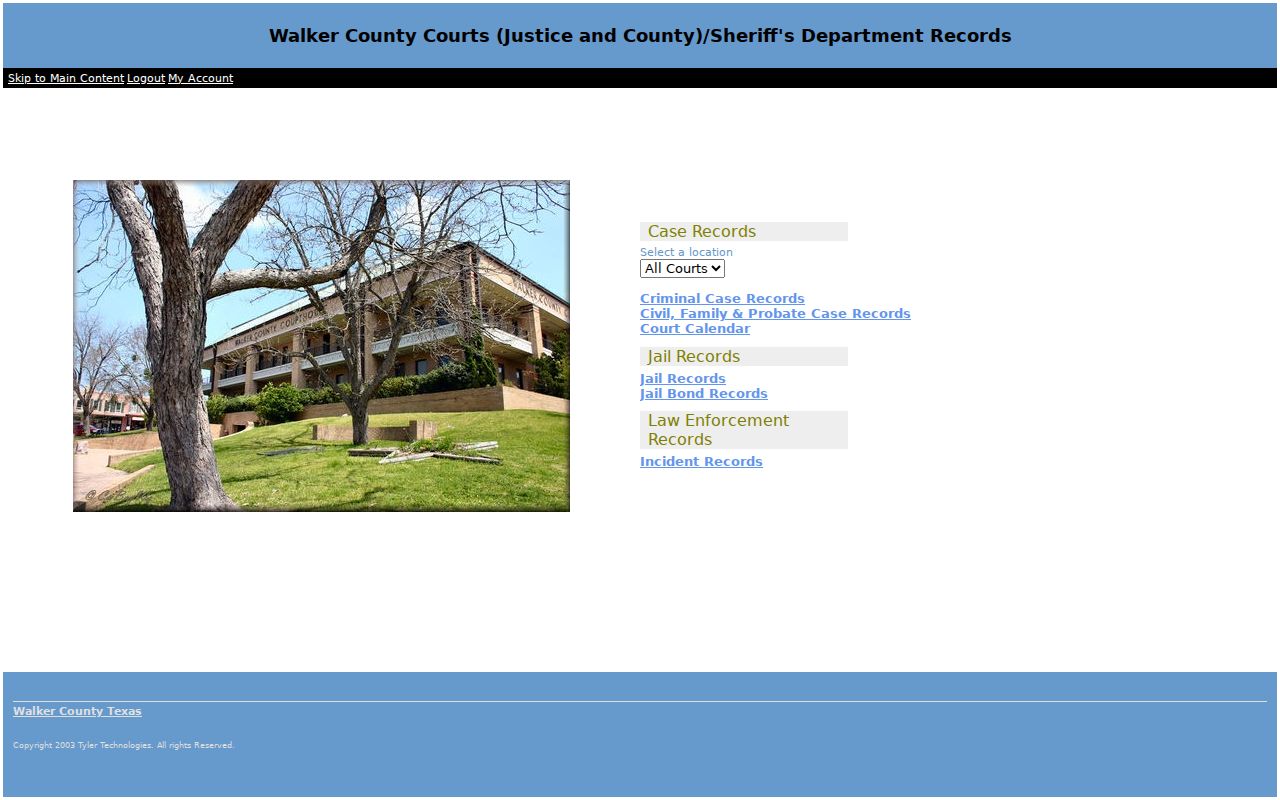
The separate tiles make it important to record which database produced a result before interpreting it.
Access & Restrictions
Texas court access is governed by judicial rules and court-specific practices, not simply by treating a clerk as an executive-agency records office. Public Walker County criminal case summaries can omit sealed or expunged matters, juvenile information, protected victim and minor data, Social Security numbers, medical details, and security-sensitive material. An online redaction does not always mean the entire paper or electronic file is closed, so ask the clerk whether a releasable version exists.
Texas Judicial Branch access standards provide the statewide framework. Government Code Chapter 411 separately limits dissemination of criminal-history record information held by DPS. Chapter 55A governs expunction of qualifying arrest records. Those systems can affect what appears publicly, but only a signed order and later record review establish that relief has been implemented.
Federal cases form another boundary. Walker County lies in the Houston Division of the Southern District of Texas, so federal criminal dockets are outside the county portal. The official PACER court-record system provides that search channel.
The PACER source illustrates the separate federal account and court-search route.
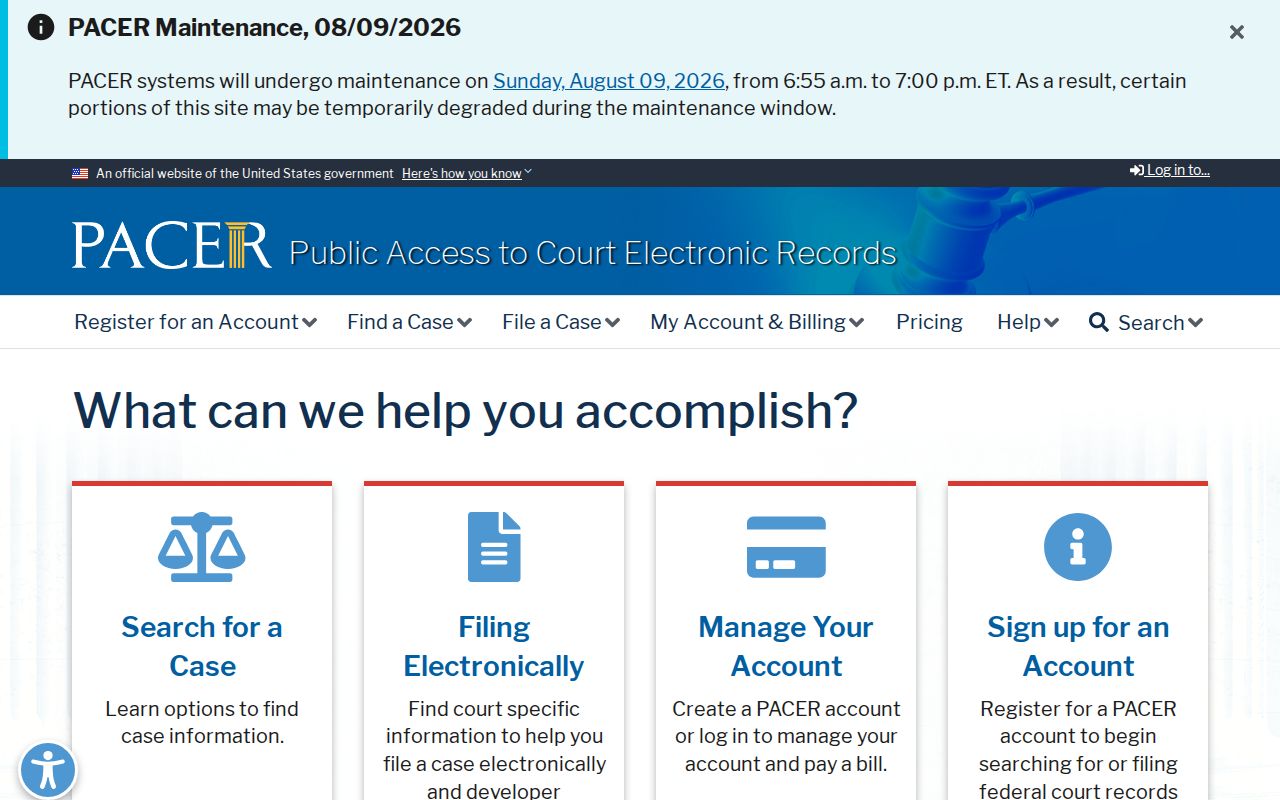
A federal result should never be described as a Walker County clerk record, even when the conduct occurred within the county.
Walker Court Dispositions Reach DPS
Local and state records connect through reporting, but they are not copies of each other. Fingerprints can create a Texas DPS Computerized Criminal History arrest cycle with a tracking-control number. If prosecutors file a Walker County criminal case, the clerk later reports its disposition through the state criminal-justice reporting chain. DPS attempts to associate that result with the matching arrest cycle. Gaps occur when identifiers do not align, fingerprints were not taken, or an event was not linked.
For that reason, a Walker County case summary may show motions, hearings, and a judgment absent from the public DPS name search. DPS generally exposes a public slice of convictions and deferred adjudications, not the whole court file. A person correcting their own state record should obtain the certified Walker County disposition and follow the Texas Department of Public Safety personal-review process. The Walker County arrest history also remains distinct from the filed court outcome.
Note: A court disposition can take time to reach the state repository, so verify a mismatch with both the clerk and DPS.