
How to Check Criminal History in Walker County
No one search holds every Walker County criminal record. Begin with the official Walker County Tyler/Odyssey portal, which presents court, sheriff, and Jail Records areas. Pick the area that matches the question. Court summaries follow cases filed with a clerk. Jail results focus on booking and current custody. A name, careful spelling, and a known filing or booking period help narrow a result. A cause number or booking number is better because it points to one local record.
Then confirm the person and the event through the actual custodian. The District Clerk holds felony files. The County Clerk handles Class A and B misdemeanor records, while a city court keeps its fine-only matters. The sheriff or arresting police agency holds its own report. Texas DPS holds reported statewide criminal-history events, but its public name product is not a full copy of every local file.
- Choose Courts, Sheriff's Department, or Jail Records in the county portal.
- Search an exact cause or booking number first. Otherwise use the full name and a useful date range.
- Compare the court, charge, dates, and other displayed identifiers. Do not rely on a name alone.
- Ask the District Clerk, County Clerk, jail, or arresting agency for details missing from the summary.
- Use a fingerprint-based DPS personal review when the goal is to verify your own statewide identity record.
Walker County Records Portal
The county portal can place several record domains behind one landing screen. That does not merge them. Select the court side for a filed case and the Jail Records area for custody or booking data. The county's official homepage also routes readers to departments when the portal summary is too thin. The captured view is the county's own navigation.
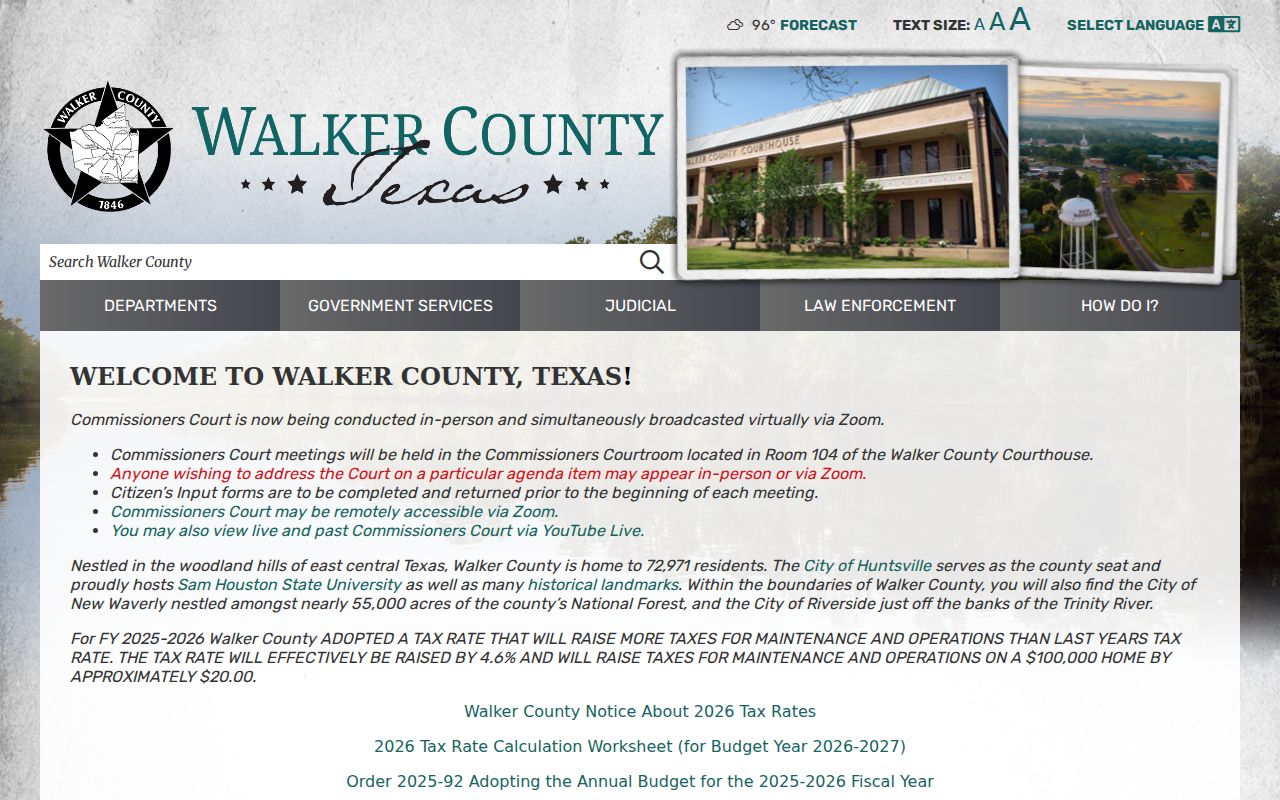
The department links matter because a public summary may omit an attachment, an old judgment, or a police narrative that must be requested from its own custodian.
The portal controls can vary by module or session. Common fields include record area, name, case number, date filed, court, and status. A blank result is not proof that no record exists. It may mean the event belongs to a different court, has not yet reached the clerk, falls outside an online archive, or is restricted by law.
| Portal field | Best use | Key limit |
|---|---|---|
| Record area | Separate court, sheriff, and jail data | Choose the correct domain first |
| Name | Find possible party or booked-person matches | Common names need more checks |
| Case number | Reach one local cause | Must match the clerk's format |
| Date or court | Narrow a broad list | Availability varies by module |
Official Texas Background Checks
The Texas Department of Public Safety Crime Records Division maintains the Computerized Criminal History system. Its Criminal History Name Search gives public access to certain reported convictions and deferred adjudications. It does not promise a full arrest history or every court document. Each search uses one $1 credit, including a no-hit search. Credit card purchases add 2.25 percent per credit and a 25-cent transaction charge.
The official DPS interface is a statewide layer, not a Walker County clerk screen.
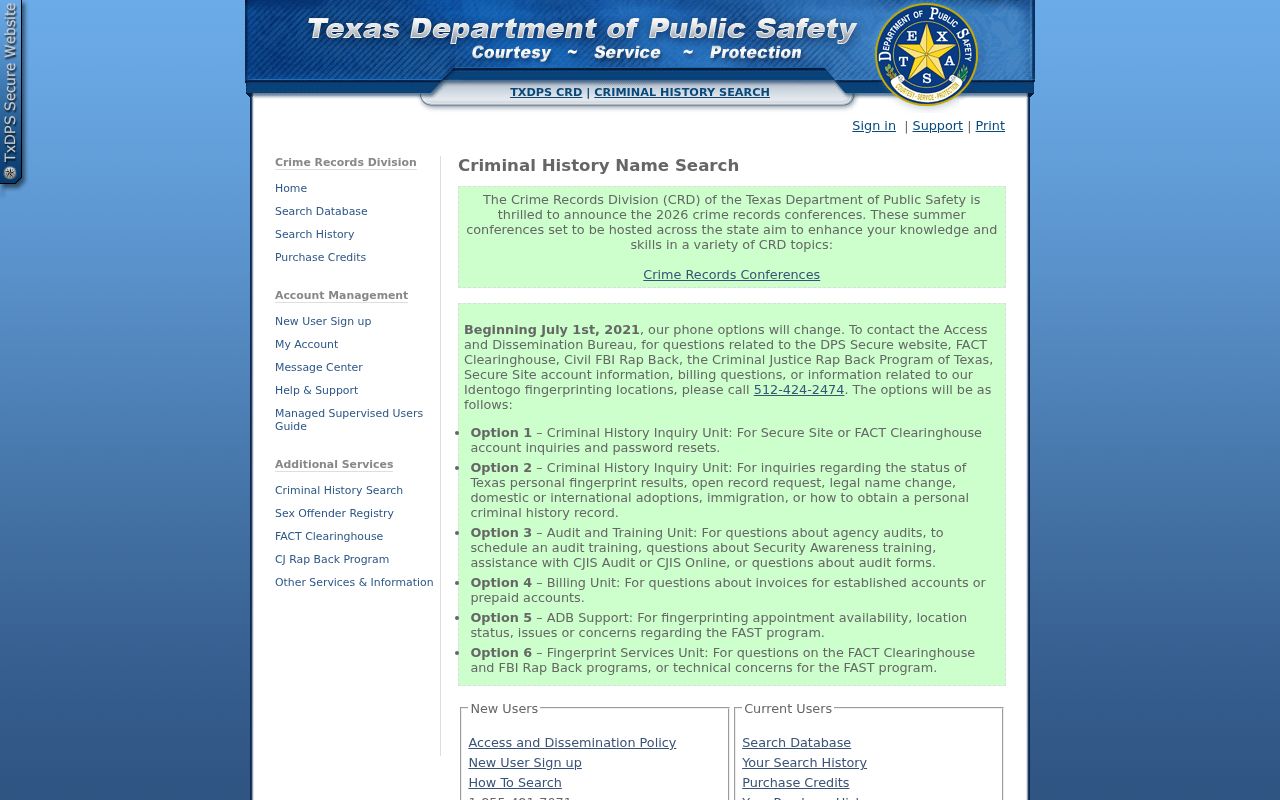
DPS matches names and birth data, including partial and Soundex methods. The agency warns that only fingerprints establish positive identity. Review likely matches before spending another credit, then compare any reported event with the Walker County case file that supplies the charge history and final court action.
The DPS search help explains credits, match previews, and the limits of name-based identity.

That guidance is a reason to save the result at search time and verify a candidate against the local court record before drawing a conclusion.
Walker County Fingerprint Self-Review
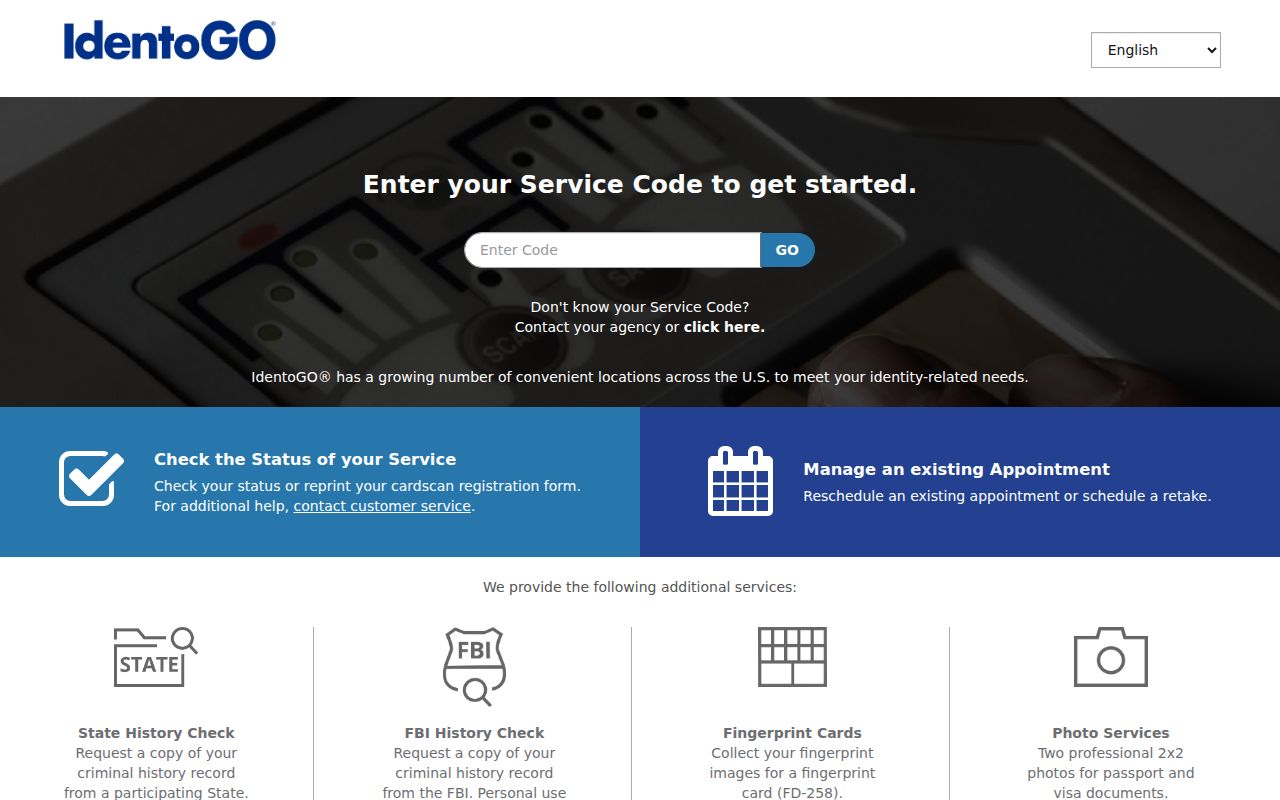
A person reviewing their own Texas record can use the DPS fingerprint process through Fingerprint Applicant Services of Texas, known as FAST. Start with the DPS fingerprinting instructions, obtain the correct service code, and then schedule with IdentoGO by IDEMIA. The service code controls the purpose, routing, appointment choices, and charge. Walker County research did not confirm a local walk-in site or one fixed total fee, so the live enrollment screen is the safe source.
The official appointment interface shows why the code comes before the site search.
If the personal review shows the wrong person or a missing disposition, follow DPS correction instructions. A certified Walker County judgment may be needed so the reporting clerk or agency can correct the source data. DPS cannot create a court outcome that was never reported.
Types of Criminal Records
Walker County agencies create separate records as a matter moves through the system. The arresting agency writes an incident or arrest report. The jail makes an intake and custody file. A magistrate records warnings, probable cause, counsel issues, and bail. Prosecutors and courts later create a complaint, information, indictment, docket, judgment, or dismissal. DPS may link the arrest cycle to a reported disposition through fingerprints and tracking identifiers.
Custody and supervision also split by agency. Walker County Jail shows local pretrial or short-term custody. The Texas Department of Criminal Justice keeps state prison information and the Texas Board of Pardons and Paroles handles parole decisions. The Texas Public Sex Offender Registry is a distinct Chapter 62 safety tool. It is not a broad criminal-history search.
- Arrest and booking: agency allegations, intake data, charges received, bond, and custody status.
- Court case file: filed charges, docket events, pleas, orders, outcome, and sentence.
- DPS history: the public slice of statewide events successfully reported and matched.
- Warrant or capias: court-issued process that must be checked with the issuing court.
- Supervision and registry: separate CSCD, TDCJ, parole, and registration records with different access rules.
Three Walker County Record Answers
A booking entry, court file, and DPS response can all be accurate while showing different facts. Booking data records the charge received at intake. Prosecutors may later decline, reduce, or change that charge. The court file tracks what was actually filed and how each count ended. DPS publishes only the public portion of events reported into the statewide system, so it may not show a fresh booking or the full docket.
| Source | Question answered | Best confirmation |
|---|---|---|
| Walker County Jail | Was the person booked or in local custody? | Booking number and current jail status |
| Walker County court clerk | What charge was filed and how did it end? | Cause number, docket, and signed judgment |
| Texas DPS | What public statewide history was reported? | Fingerprint-based personal review |
This split is vital in Walker County, where county jail, state prison, and federal custody searches can all surface in a Huntsville inquiry. Use the record number and custodian, not the city name alone.
What a Walker County Criminal Record Shows
The contents depend on the record. A repository history groups events by identifying data and arrest cycle. A court file uses a cause number and chronological docket. A booking file centers on intake and custody. Public views can omit Social Security numbers, medical information, protected victim or juvenile facts, and data sealed or restricted by law.
| Name & Identifiers | Reported names, aliases, birth date, sex, race, SID, FBI number, or fingerprint-linked keys where public. |
|---|---|
| Arrest / Booking Data | Agency, arrest and booking dates, tracking or booking number, received charges, bond, and custody status. |
| Charges & Statutes | Offense text, count, level, and legal citation as entered by the agency or court. |
| Disposition | Pending status, dismissal, acquittal, deferred adjudication, or conviction tied to a particular count. |
| Sentence | Confinement, fine, restitution, community supervision, and other terms shown in the judgment. |
| Custody / Supervision Status | Local jail, state custody, parole, or community-supervision data from the agency that maintains it. |
- Disposition
- The outcome or current status of a filed charge.
- Deferred adjudication
- Community supervision without an immediate judgment of guilt; it does not erase the record by itself.
- Capias
- Court process directing an arrest, often after a case event.
- Community supervision
- The Texas term commonly called probation.
Walker County Records Buildings
Walker County record work is split between two nearby hubs. The historic courthouse at 1100 University Avenue holds the District Clerk in Room 209 for felony files and the County Clerk's misdemeanor function for County Court at Law matters. The Sheriff's Office and Justice Building at 717 FM 2821 West houses sheriff administration and Huntsville Municipal Court. The jail sits separately at 655 FM 2821 West.
The official Sheriff's Office location page shows the FM 2821 facility.
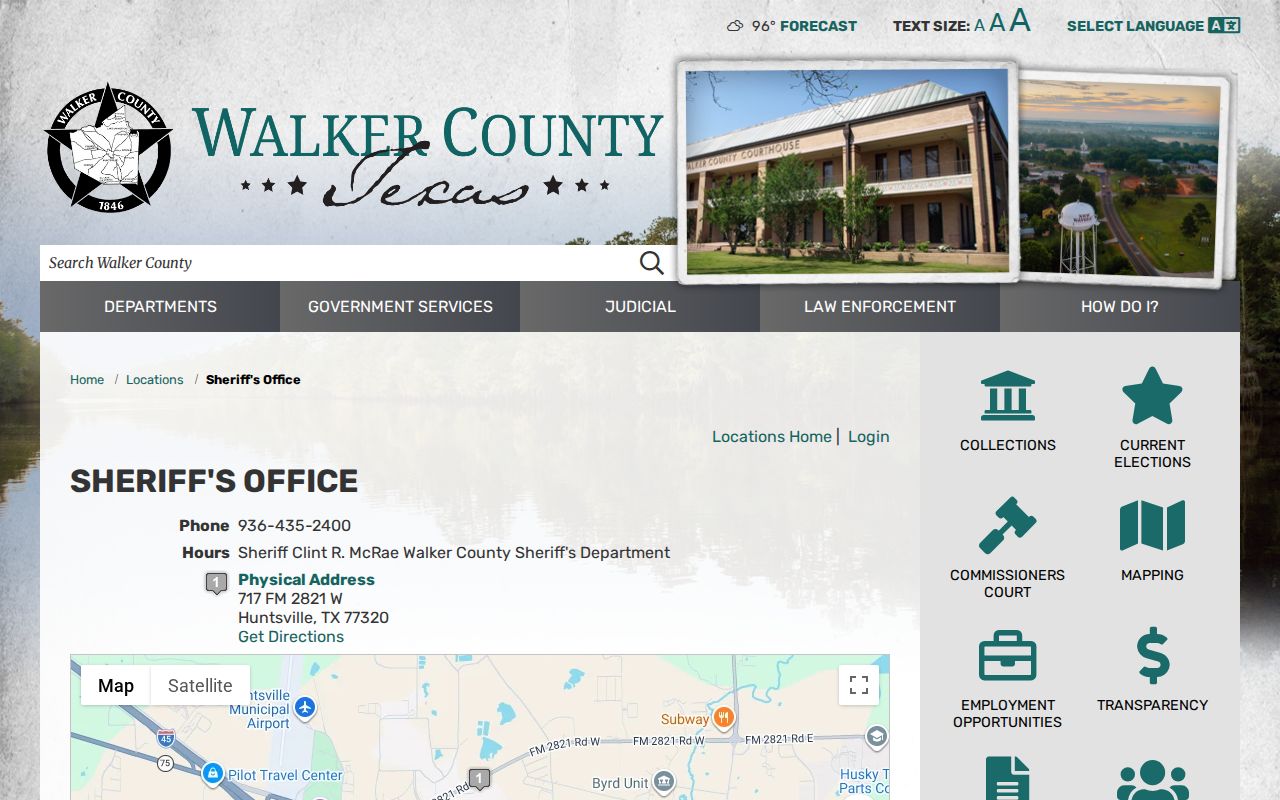
Sharing a building does not merge custodians. A Huntsville citation belongs to Municipal Court, while a sheriff report belongs to the Sheriff's Office. Filed felony and Class A or B misdemeanor records remain with the courthouse clerks.
District Clerk
1100 University Ave., Room 209
Huntsville, TX 77340
936-436-4972
wcdc@co.walker.tx.us
County Clerk Misdemeanors
1100 University Ave.
Huntsville, TX 77340
936-436-4696
Verify division hours before travel.
Sheriff's Office
717 FM 2821 W., Suite 500
Huntsville, TX 77320
936-435-2400
Fax 936-435-2440
Public Access Laws
Access starts with the custodian and the law that governs that record. The Texas Public Information Act applies to releasable sheriff and police material, subject to exceptions. Court files are controlled by judicial access rules and court-specific procedures. DPS criminal-history data is confidential unless Chapter 411 authorizes release, with Section 411.135 defining the public conviction and deferred-adjudication product.
Key Statutes:
Government Code § 552.021 gives access to public information during normal business hours, subject to statutory exceptions.
Government Code §§ 411.083 and 411.135 explain confidential DPS history and the narrower public product.
Texas judicial access rules govern court records rather than treating a clerk as a standard executive-agency custodian.
Code of Criminal Procedure Chapter 55A controls expunction of qualifying arrest records.
A written request should name an existing record, incident, date range, and preferred delivery form. It should not ask an office to answer a legal question. Agencies may redact protected data or seek an Attorney General decision when an exception may apply.
Walker County Warrant Records
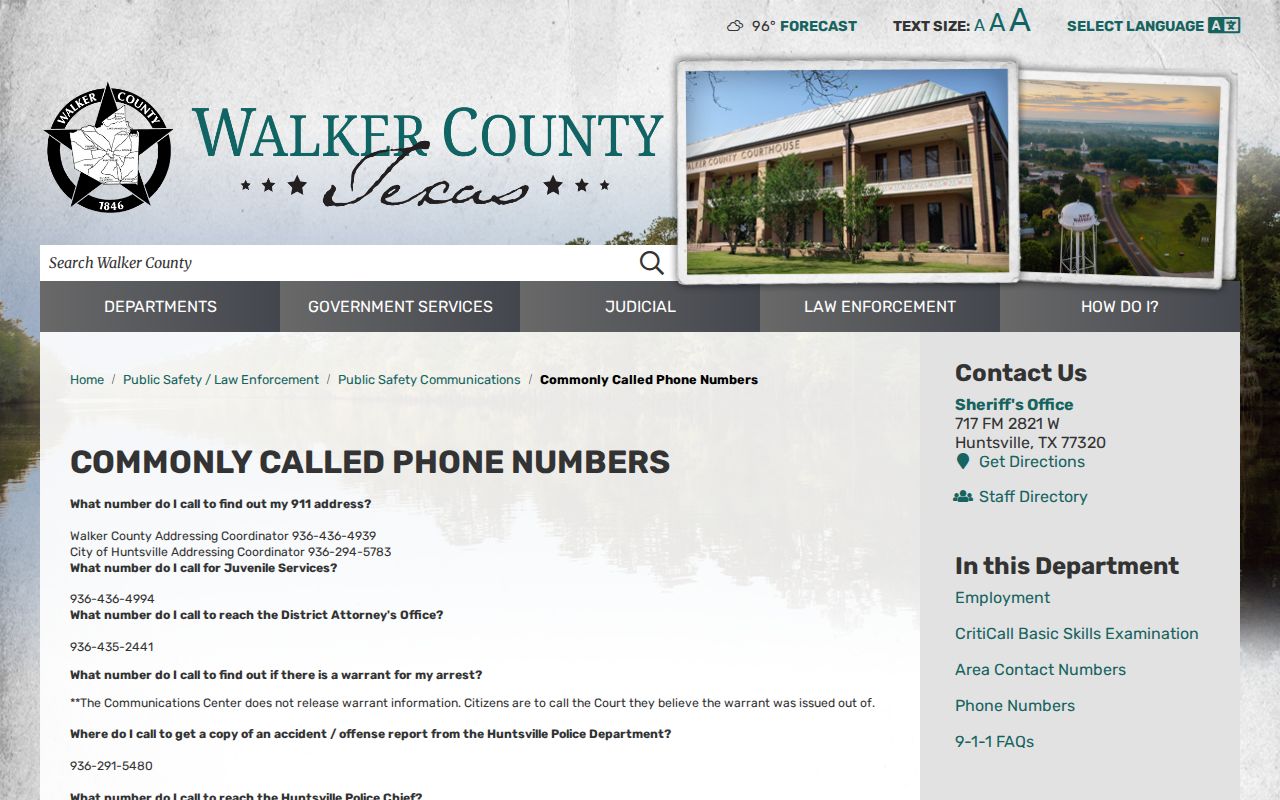
Walker County publishes one unusually clear warning: Communications does not release warrant information. Call the court believed to have issued the warrant. No verified countywide active-warrant portal was found, and an empty Jail Records result is not a clearance. Felony indictment warrants or capias matters route to the District Clerk. County Court at Law misdemeanor warrants route to the County Clerk. Huntsville citation warrants route to Municipal Court, while justice-court warrants stay with the specific precinct court.
The county's direct-number page documents this routing rule and key phone lines.
Ask the issuing court for the exact cause or warrant number, current status, bond or payment condition, and next instruction. If a warrant has been executed, check the jail at 936-435-2412. Keep the receipt or signed order after resolution because court and law-enforcement systems can update at different times.
Sealed, Expunged & Restricted
Texas expunction and an order of nondisclosure are different forms of relief. Chapter 55A can direct return or destruction of qualifying arrest records. Nondisclosure restricts ordinary public release but leaves the record available to criminal-justice and other agencies named by law. Eligibility turns on the exact arrest episode, charge, disposition, prior history, offense exclusions, and waiting rules. A dismissal does not automatically clear every connected database.
Walker County provides expunction resources through the District Clerk criminal division. Gather the arresting agency, date, charge, cause number, tracking identifiers, certified disposition, and each agency that may hold the event. Chapter 55A replaced the old Article 55.01 organization on January 1, 2025, so an older form may cite obsolete numbering. The research did not locate a current total Walker County filing fee.
| Feature | Expunction | Nondisclosure |
|---|---|---|
| Main law | Code of Criminal Procedure Chapter 55A | Government Code Chapter 411, Subchapter E-1 |
| Effect | Qualifying records returned or destroyed as ordered | Public disclosure restricted; record remains |
| Walker route | Generally District Court through the District Clerk | The court directed by the statute and underlying case |
Walker County Misdemeanor Archives
Older Walker County misdemeanor research has a sharp local cutoff. The County Clerk reports no misdemeanor files before 1962 and only judgments for the years 1962 through 1987 under the retention schedule. That gap is not proof that no arrest or case occurred. Researchers should identify the court and time period before ordering a search, then ask whether a judgment, index entry, or another surviving record exists.
The County Clerk charges $5 for a name search, or per case when more than one case is found, plus $5 for certification and $1 per page. Credit card handling adds $3. A mailed request needs payment and a self-addressed stamped envelope. Felony copies use the District Clerk's current fee schedule instead. The District Clerk page advertises a schedule effective September 1, 2025, so misdemeanor prices should not be assumed for felony work.
Criminal Records by City in Walker County
Huntsville, New Waverly, and Riverside are Walker County's three incorporated cities in population order. A city agency keeps the report it created, and a municipal court keeps its own fine-only cases. County jail, felony, and Class A or B misdemeanor records still route to county custodians. Start with the city page when the arresting agency or citation is local, then follow the record to the jail or courthouse if the matter moved beyond city jurisdiction.
Huntsville Criminal History
45,941 at the 2020 Census · HPD Records, Municipal Court, and SHSU Police add distinct local routes.
New Waverly Criminal History
914 at the 2020 Census · confirm the arresting agency and use the city court for fine-only cases.
Riverside Criminal History
522 at the 2020 Census · use the city request route or county custodian based on who made the record.
Walker County Custody Record Systems
Huntsville's role in the Texas corrections system creates a common records trap. A person described as an inmate in Huntsville may be in Walker County pretrial custody, a Texas prison, or federal custody. The Walker County Tyler portal and jail line answer the first question. The TDCJ Online Inmate Search covers state custody. The Bureau of Prisons locator covers federal custody.
The statewide court platform adds another layer. The official re:SearchTX landing page shows the statewide case-search entry point.
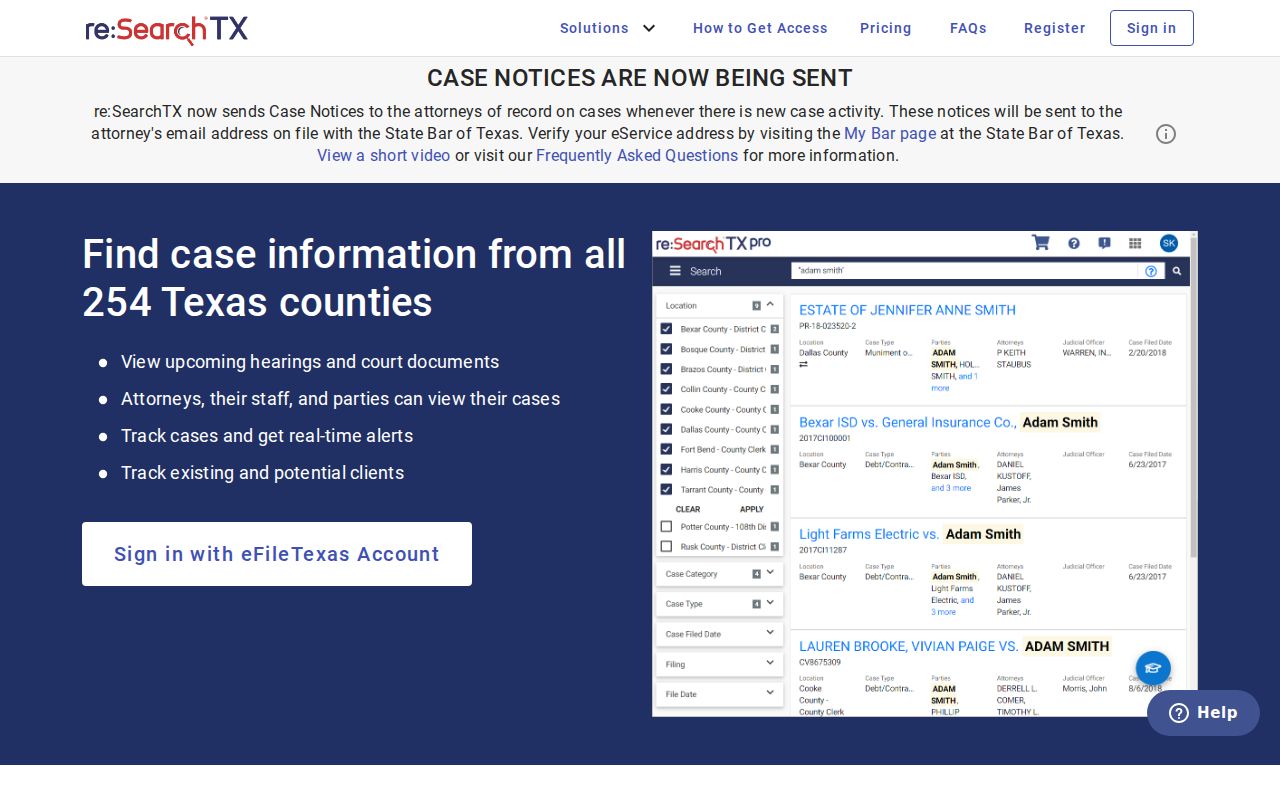
Document availability and charges depend on participating courts. Walker County's own portal remains the first local summary source, while the relevant clerk supplies certified documents.
Parole is separate from both jail and court search. The Texas Board of Pardons and Paroles makes parole decisions, and the TDCJ Parole Division supervises releasees.
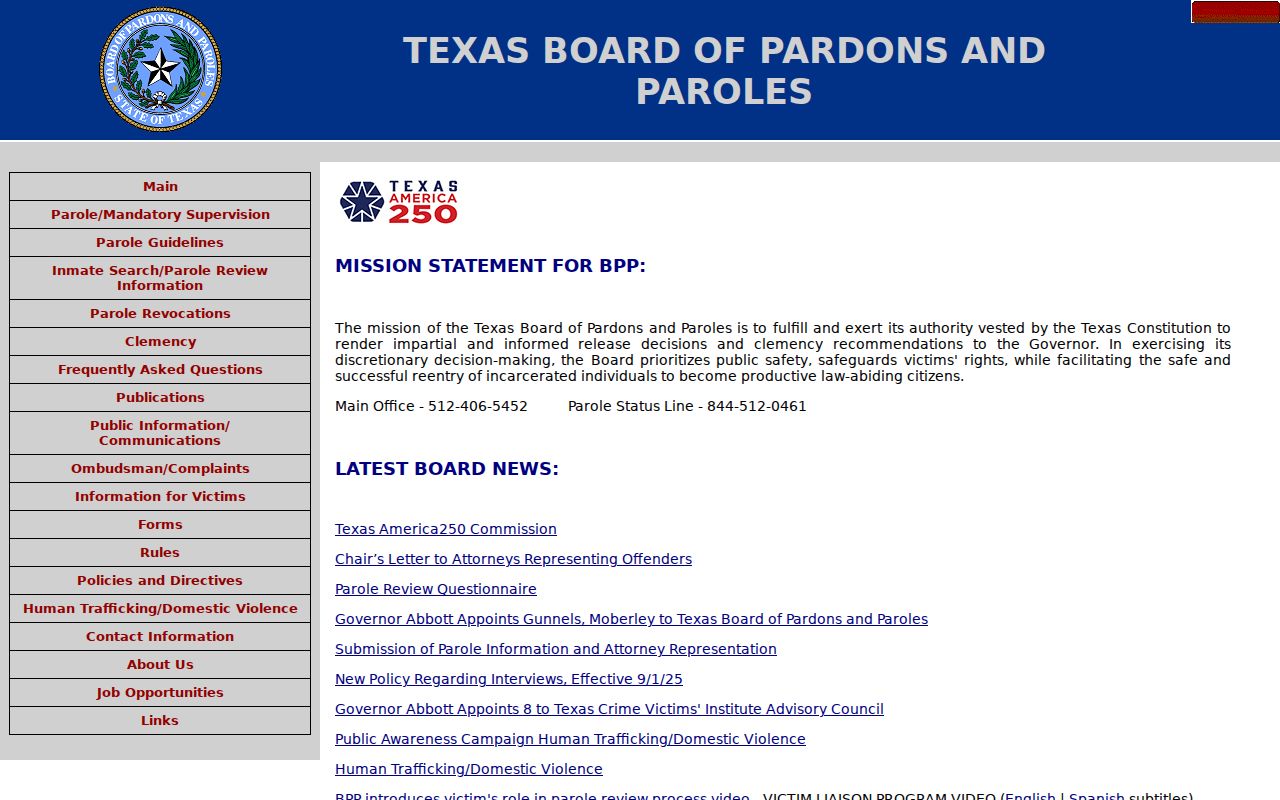
A Walker County judgment is the public source for a sentence, while TDCJ systems supply later state custody or parole status. Community supervision, Texas's term for probation, is run locally by Walker County CSCD and is not shown by a jail search.